The land surrounding Rainbow Falls has witnessed more than a century of American frontier history. Long before off-road enthusiasts discovered its trails, these hollows sheltered moonshiners, outlaws, and Civil War soldiers. The same remote terrain that makes Rainbow Falls a hidden gem today once made it the perfect refuge for those who lived — and sometimes died — outside the law.
The Moonshine Era
Wildcatters of Dry Creek
In the late 19th and early 20th centuries, the remote hollows of Hardin County — including the Dry Creek community — were among the most active moonshining territories in West Tennessee. The dense forest, hidden ravines, and proximity to fresh creek water made these hills ideal for illicit distilling operations.
Federal Alcohol Tax Unit investigators Charles Dickey and Stanley Frye, operating out of Jackson, Tennessee, led a 10-day campaign that resulted in the destruction of 13 moonshine stills in Hardin County alone. Among the communities named in their reports: Dry Creek — the very area where Rainbow Falls flows today. The raids destroyed 7,995 gallons of mash at those 13 stills.
The dangers were not merely legal. U.S. Treasury Department supervisor Robert P. Lane warned that 81 percent of illegal whiskey samples from Tennessee contained lead salts — with 35 percent containing quantities sufficient to cause death.
"The ingestion of lead salts in excessive quantities causes an accumulation of lead in the body tissues which may, over a period of time, result in death, paralysis, or blindness."
— Robert P. Lane, U.S. Treasury Department
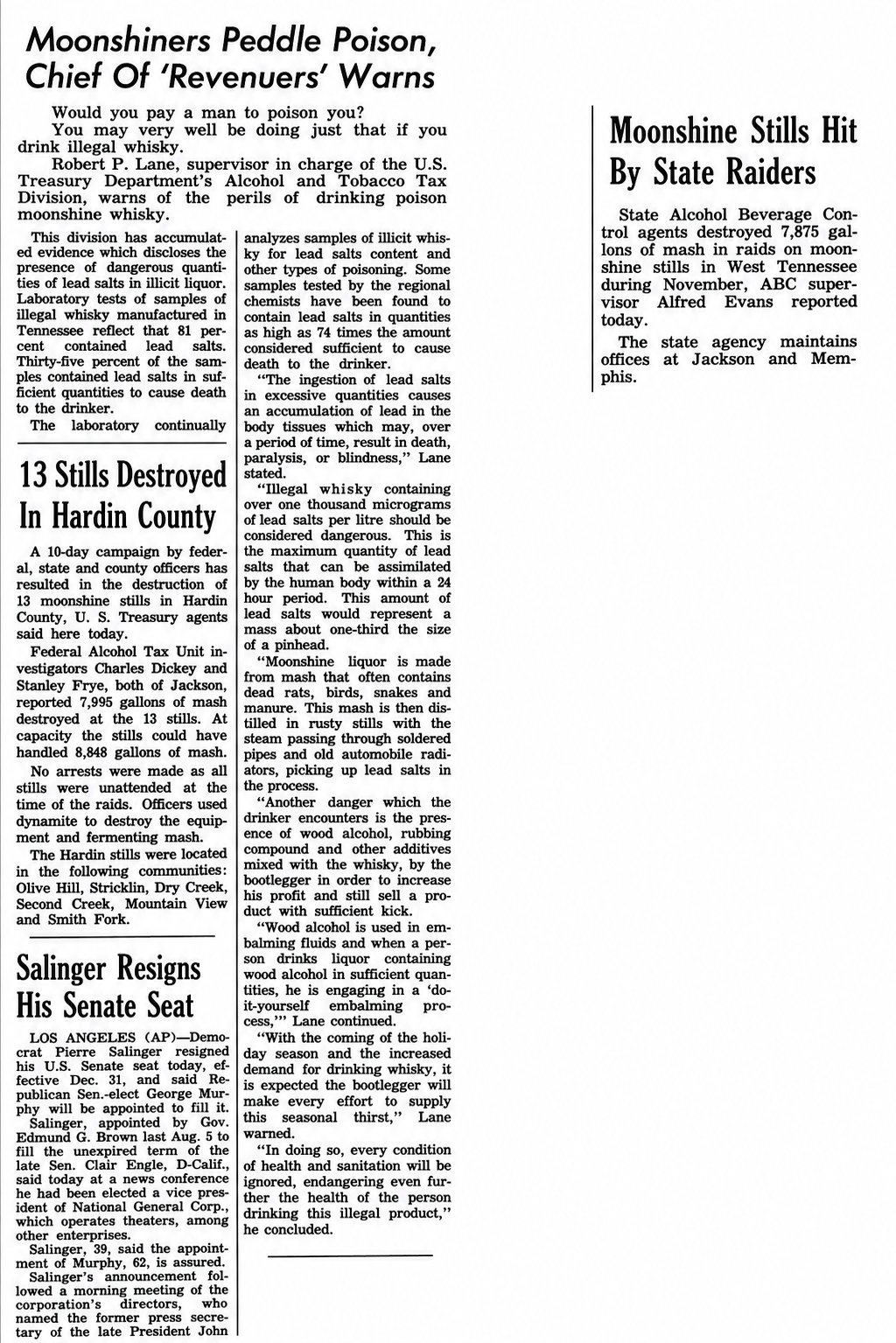
Original newspaper articles documenting moonshine raids in Hardin County, including Dry Creek
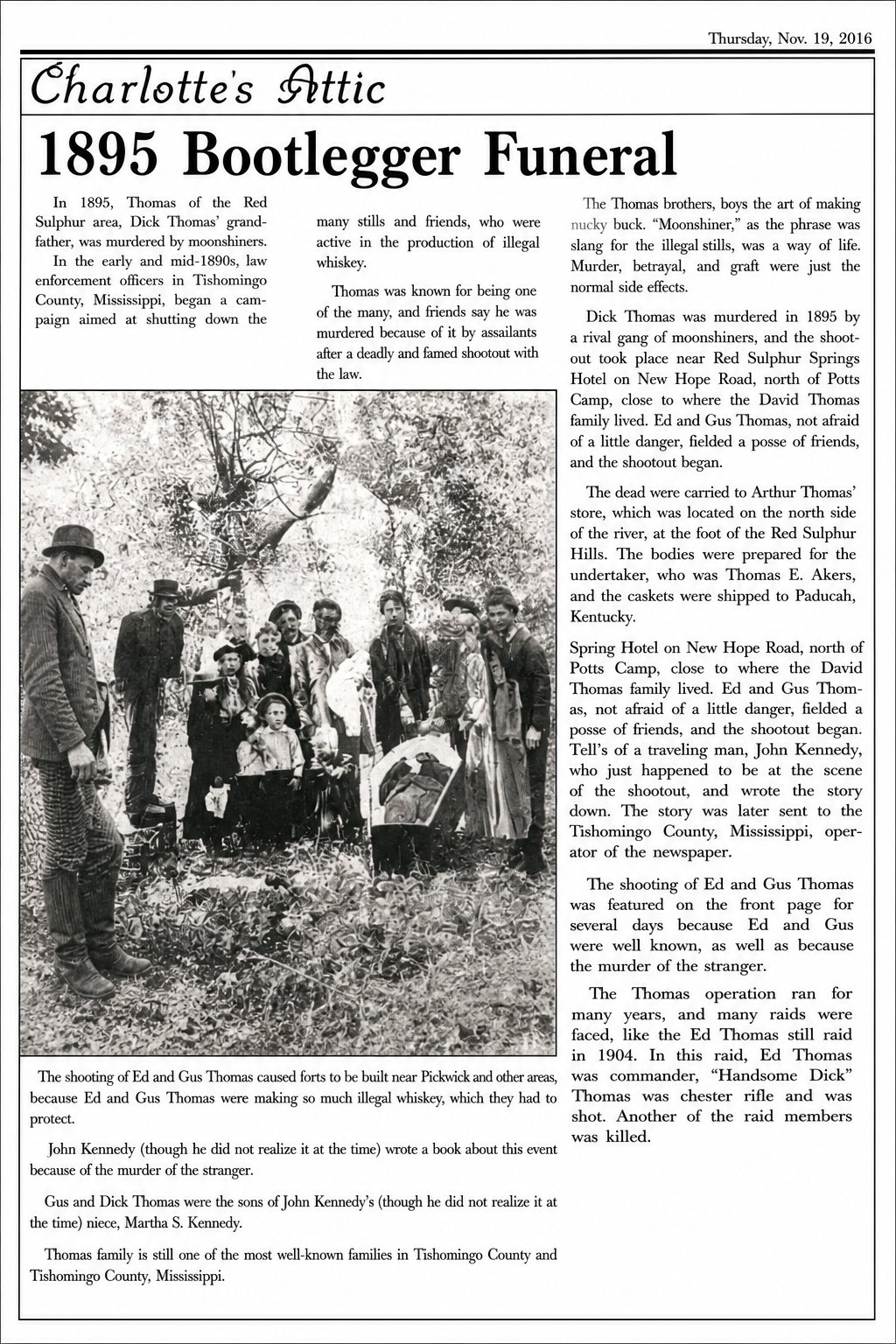
"Charlotte's Attic" — 1895 Bootlegger Funeral, published November 19, 2016
The Thomas Brothers
Murder, Betrayal & the Bootlegger's Funeral
Among the most notorious moonshiners of the Dry Creek region were the Thomas brothers — Ed and Gus Thomas. Their grandfather, Dick Thomas of the Red Sulphur area, was murdered by rival moonshiners in 1895, setting off a chain of violence that would span decades.
The fatal shootout took place near the Red Sulphur Springs Hotel on New Hope Road, north of Potts Camp. Ed and Gus Thomas, "not afraid of a little danger," fielded a posse of friends and the shooting began. The dead were carried to Arthur Thomas' store at the foot of the Red Sulphur Hills, and the caskets were shipped to Paducah, Kentucky.
A traveling man named John Kennedy happened to witness the event and later wrote a book about it — not realizing at the time that Gus and Dick Thomas were the sons of his own niece, Martha S. Kennedy.
Gus Thomas ran from the law for years, with a $400 federal reward on his head. He was finally captured hiding under the floorboards of John Counce's home, where officers ripped up the planks one by one until they found him crouched in the darkness below.
Outlaw Lore
Jesse James & the Pickwick Plantation
Local legend holds that Jesse James and his gang used the remote terrain of Hardin County as a refuge after robbing the Corinth Bank. The Pickwick Plantation — a colonial-era estate on Highway 57 near Counce, Tennessee — is said to have sheltered the James gang during their time in the area.
The James brothers had a well-documented pattern of using Tennessee's remote hollows and sympathetic locals as cover between raids. The same geography that made Dry Creek ideal for moonshining — deep ravines, dense forest, and sparse law enforcement — made it equally attractive to outlaws on the run.
Jesse James also committed one of his final crimes in this region: robbing the U.S. Army Corps of Engineers payroll being delivered near the Tennessee River — just miles from what is now Pickwick Lake. The Corps of Engineers later built Pickwick Landing Dam in the 1930s, flooding several communities and forever changing the landscape of Hardin County.
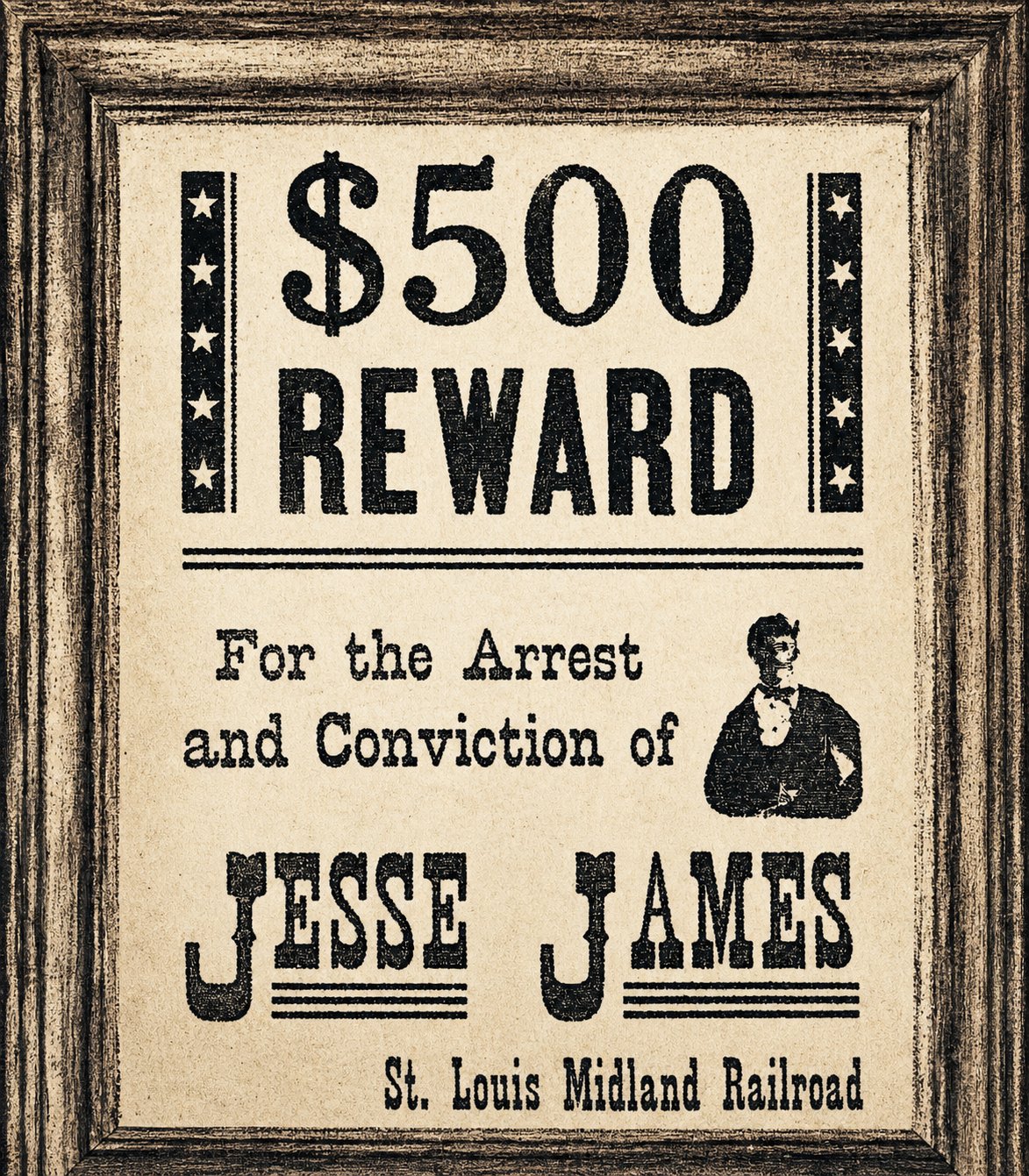
$500 Reward for the Arrest and Conviction of Jesse James — St. Louis Midland Railroad
April 6–7, 1862
The Battle of Shiloh
Hardin County, Tennessee was the site of one of the bloodiest battles of the American Civil War. On April 6–7, 1862, Union and Confederate forces collided at Pittsburg Landing — just a few miles from Savannah — in what became known as the Battle of Shiloh. Nearly 24,000 men were killed, wounded, or listed as missing in just two days of fighting.
Savannah itself served as the headquarters for Union General Ulysses S. Grant's Army of the Tennessee during the campaign. The Cherry Mansion in Savannah was Grant's command post in the days leading up to the battle.
The Tennessee River — now dammed to form Pickwick Lake — was a critical strategic waterway during the war. Union gunboats used it to move troops and supplies, while Confederate forces fought to control the river crossings.
The Shiloh National Military Park, just south of Savannah, preserves the battlefield and stands as a testament to the sacrifices made in this corner of West Tennessee. The park is a short drive from the Rainbow Falls area and is well worth a visit.
Hardin County Through the Ages
The TVA Legacy
Pickwick Lake & the Lost Towns
In the 1930s, the Tennessee Valley Authority constructed Pickwick Landing Dam on the Tennessee River, creating the vast reservoir now known as Pickwick Lake. The project was part of FDR's New Deal — designed to bring electricity, flood control, and economic development to one of the poorest regions of the country.
But the dam's creation came at a cost. Several communities in Hardin County, Tennessee; Tishomingo County, Mississippi; and Colbert and Lauderdale counties in Alabama were permanently flooded. Families who had farmed these river bottoms for generations were relocated, their homes, churches, and cemeteries submerged beneath the rising waters.
Today, Pickwick Lake stretches 53 miles along the Tennessee River, offering world-class fishing, boating, and recreation. The lake's proximity to the Dry Creek OHV area makes it a natural complement to a Rainbow Falls adventure — many visitors combine a day on the trails with an evening on the water.